
Ant colonies don’t necessarily die out over winter, unlike other insects – so how do you get rid of them? What are your options?
Read on to find out more!
How do I get rid of ants in the house in the winter?

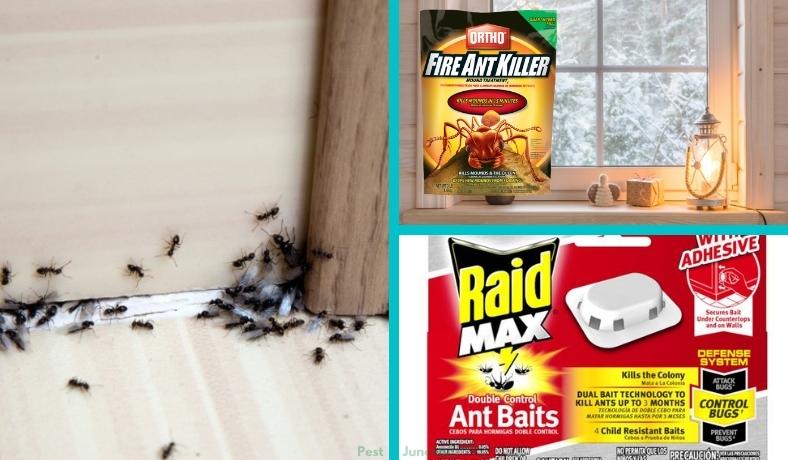
To get rid of ants in your home during the winter, generally using bait is the most effective option. Another option if that isn’t helpful is a commercial trap which attracts and captures ants that are drawn to great.
You can also use a home recipe:
- Mix a 1/4 teaspoon of boric acid with 4 tablespoons of peanut butter.
- Apply near where you believe the ants are the most common and/or where they come into your home.
- This isn’t a fast process – the ants will both consume and take the bait back to the colony where they’re die over time. It can take weeks or months so it’s definintely not my first choice.
How long does it take to get rid of ants?
Ants can be a very persistent nuisance in your house. While spraying pesticide on visible ant mounds or on ant trails may kill a few worker ants, in order to eliminate an ant infestation, it’s vital to kill the queen ant that lays eggs.
Without a queen an ant colony will soon die out. Ant bait traps work but will depend on the amount of them invading your home – ususually days to a week or so. For that reason I recommend keeping ant spray handy to deal with others in the meantime.
Why am I getting ants in my house in the winter?

Ants in nature survive the winter through a variety of adaptations. They can huddle together for warmth in their nest and they can enter a state similar to hibernation.
The easiest way for ants to survive the winter is to move all or part of their colony into a warmer place, like a house, so they’re attracted to that as well as having a source of food and water to scourage for.
Is it normal to have ants in the winter?
As long as the temperature is above freezing they and will remain active. The presence of ants in your house in winter means that it’s very likely that an ant colony has moved into the foundation of your house, some other hidden corner, or somewhere nearby close to shelter.
Why are there ants in my room if there is no food?

Ants need more than just food. They need a steady supply of water and will search for it in your house if their regular supplies aren’t available. Ants are also sometimes attracted to humidity.
They’re nature’s scavenger and forage relentlessly. If they’ve found food in your house in the past they’ll usuall return regularly to look for more even if there’s none at the moment.
As ants forage, they leave a tiny chemical trail behind them both to find their way back to their nest,and to guide others. An ant scenting the trail of a predecessor will often follow to see if anything worthwhile can be found.
If the ants don’t find anything interesting right away they’ll usually wander around looking for food or water.
Ants also need shelter. If the temperature outside is too hot or too cold for them to survive in their regular nest they may come into your house looking for a new place to live.
Their colonies reproduce by sending out winged ants who may fly to your home and seek to set up housekeeping.
How do you treat an infestation of ants in your home?

Look for ant nests in your foundation or around your house. While it’s tempting to spray pesticide on any visible ant heaps near the home, and this will kill many of the worker ants, if the queen ant isn’t killed the colony can continue to exist and will eventually replace all of the workers.
There are several natural remedies that can eliminate ants.
- Borax is toxic to ants. You can mix three parts of granular sugar to one part borax, and put it out as a powder, or dissolve the whole in water to make a syrup. The ants will carry the mixture back to their nest and add it to their food supply.
While borax isn’t toxic to people in small doses you may not want to use it anywhere near pets and small children are at often.
- Cornstarch is a popular remedy but it alone does little to harm the ants. On the other hand, cornstarch can be mixed with borax to work as bait. Ants recognize cornstarch as food and will carry it back to the nest.
- Mint has long been used as an ant repellant. The scent of the mint drives ants away, and it interferes with the chemical scent trails that they use to find their way in the landscape. You can discourage ants by planting mint around the foundation of your house, and you can wipe a mix of water and peppermint or other mint oils or extracts to remove ant trails in your house.
- Cinnamon is both toxic to ants and has a scent that confuses them. You can use cinnamon oil to repel ants by rubbing it on surfaces like countertops and places where ants crawl. It also poisons ants.
- Both cayenne pepper and black pepper repel ants. Neither is poisonous to ants, but the strong scent deters them. You can sprinkle it liberally on countertops and along ant trails to discourage them.
- Boiling water or vinegar, coupled with borax, can be dumped down any visible ant hills around your house. The hot water can flood the tunnels and kill many ants though it’s at best a temporary fix unless the queen is killed. It’s especially effective with carpenter ants though.
- Although baking soda is sometimes recommended as a remedy to kill ants, there’s no good evidence that it actually works.
- Commercial ant bait traps and granular or liquid ant baits are some of the best options out there. Granular baits are taken back to the colony where they kill more and more of colony as they’re shared.
How long can an ant infestation last?
You can have an ant infestation as long as there are ants present somewhere to invade your home.
An ant colony can last as long as the queen ant lives and lays eggs. Without a queen, the worker ants can only survive for a few weeks. A queen ant can live for many years; some species can survive for decades.
If you can kill most of the colony and especially the queen using some of the solutions I mentioned above it’s possible to eliminate the problem forever (or at least until a new colony comes about).